Blog
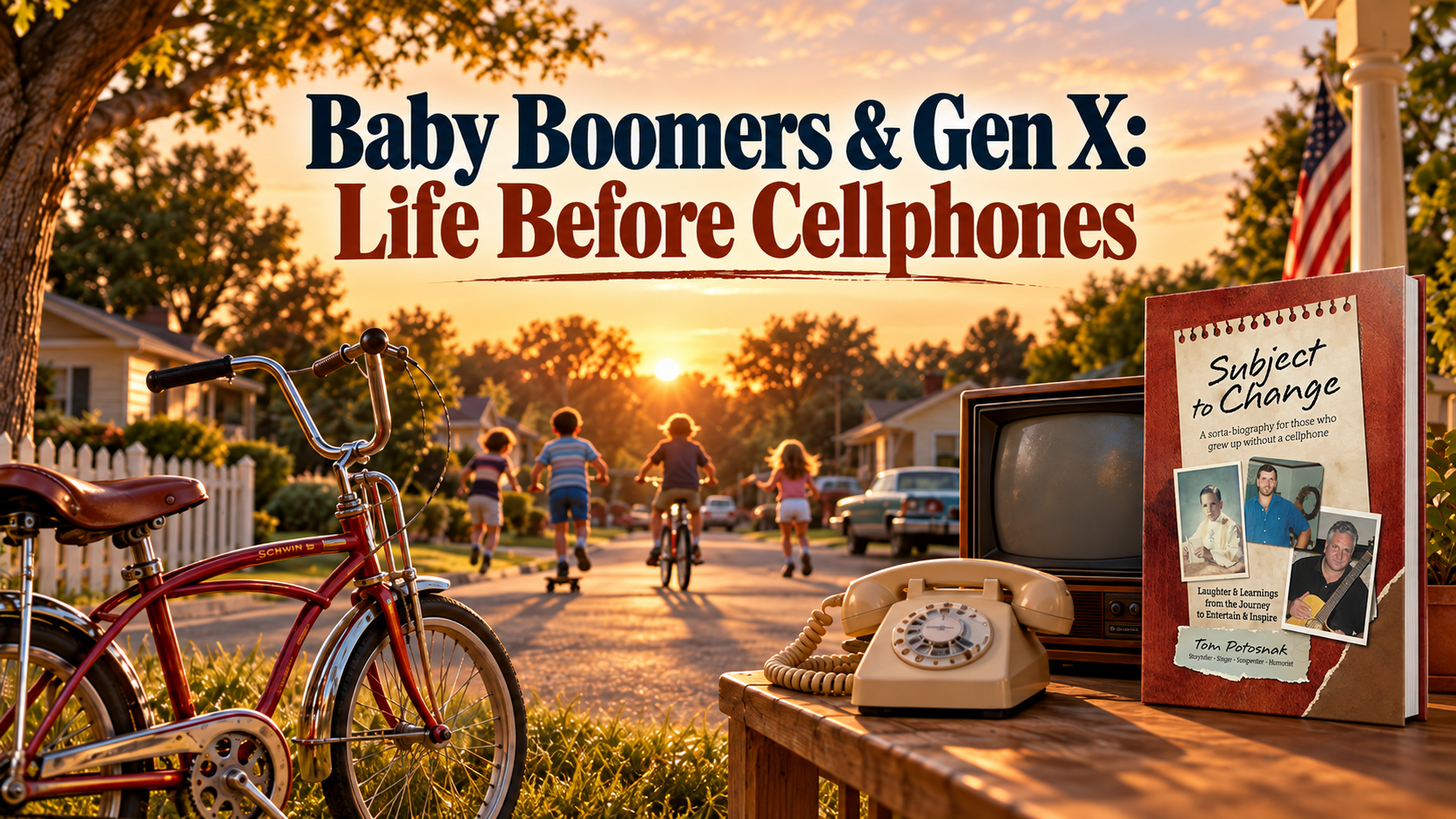
From Baby Boomers to Gen X: What Growing Up Without a Cellphone Taught Us
Remember when leaving the house meant actually leaving the house?
There was no tracking your location, no text saying, “Where are you?” five minutes after you left, and no little blue dot informing everyone that you had apparently stopped at the pizza place instead of going straight home.
You went outside. You disappeared. Somehow, civilization continued.
For much of the baby boomer generation, and for plenty of Gen Xers who came along afterward, childhood took place before anybody carried the entire world around in a pocket. If your parents wanted to know where you were, they had a highly sophisticated communications system.
They yelled your name.
If that didn’t work, eventually somebody’s mother would find you.
That pre-digital childhood is one reason Baby Boomer books, Gen X books, and generational memoirs can be so enjoyable. They remind us not simply of what we had, but of what we didn’t have—and how much everyday life changed because of it.
What Defined Childhood for the Baby Boomer Generation?
Growing up in the 1960s and 1970s meant different things depending on where you lived and what kind of family you came from. Still, many Boomers remember a childhood built around a few fairly simple ingredients: neighborhood kids, bicycles, ballfields, television, family, school, and a lot less adult supervision than most parents would tolerate today.
Summer mornings could begin with a kid walking out the door without an itinerary.
There were no scheduled “play dates.” Your social calendar consisted largely of finding out who was already outside.
You rode bikes. You played ball. You went to the lake, the playground, somebody’s backyard or wherever something interesting seemed to be happening. Parents generally wanted to know two things: roughly where you were going and whether you understood what time supper started.
That independence wasn’t necessarily the result of a carefully researched parenting philosophy. Nobody had read an article explaining the developmental benefits of unstructured outdoor play.
They just wanted you out of the house.
And we were happy to oblige.
Where Baby Boomers and Gen X Find Common Ground
Baby Boomers and Gen X are not the same generation, and pretending they had identical childhoods misses an important part of the story.
Technology was already changing quickly by the time later Gen Xers were growing up. Cable television, video games, VCRs and personal computers increasingly became part of childhood. Boomers and many early Gen Xers, however, shared more of the earlier analog entertainment world: limited television choices, landline phones and entertainment that often involved leaving the house.
That overlap may be their most interesting common ground.
Both generations experienced life before digital technology became unavoidable, and both later had to adapt as it transformed work, communication, entertainment and relationships.
We went from getting up to answer the telephone to carrying one everywhere we go.
Progress?
Absolutely.
Although there are days when that twenty-five-foot telephone cord doesn’t sound so bad.
Before Cellphones, Childhood Had Different Rules
One of the biggest differences between a pre-digital childhood and childhood today was simple: parents couldn’t watch you from a screen.
Nobody was checking GPS coordinates.
You couldn’t text home.
If something went wrong, you found a landline, knocked on somebody’s door or figured it out yourself.
Kids rode bicycles across neighborhoods, walked to friends’ houses, played outside without organized activities and disappeared until dinner. The return to my childhood neighborhood with my old friend years later illustrated how dramatically those summer scenes had changed. The streets and recreational spots he remembered being full of children seemed almost empty.
Then there was television.
Three national networks and a few local stations could create something that today’s endless streaming choices rarely do: a genuinely shared experience.
Everybody seemed to know what everybody else had watched the night before.
Today we have thousands of choices and can still spend forty minutes saying, “There’s nothing on.”
Somehow we have achieved the technological miracle of unlimited entertainment and brought boredom along for the ride.
Old-School Parenting Would Look Very Different Today
Parenting has probably changed as much as technology has.
Many Boomers grew up in homes where the parents were clearly the parents—not buddies, negotiators, life coaches or members of a household democracy.
The stories about my parents’ ways capture that with considerable humor. Let’s just say when I struggled with crying at school as a young boy, mom’s approach was considerably more severe than anything likely to appear in a modern parenting journal.
Was every old-school parenting method brilliant?
Of course not.
Were some of them effective?
Well, plenty of us are still here.
The point isn’t that one generation discovered the perfect way to raise children. Parenting changes because society changes. What seems reasonable in one era can look ridiculous—or horrifying—in another.
And someday our grandchildren will probably look back at today’s parenting techniques and ask, “You did WHAT?”
That may be one tradition every generation manages to preserve.
From Three TV Networks to Endless Scrolling
For many Boomers and early Gen Xers, television wasn’t personalized.
A family often watched the same television in the same room. I remember Saturday evenings watching sitcoms with my parents and, in retrospect, realizing those programs gave me the chance to see them laughing and temporarily outside their normal “parent mode.”
That mattered.
Entertainment wasn’t only content. Sometimes it was an excuse to be together.
Today, one person can be streaming a series upstairs while somebody else watches YouTube downstairs and three other family members scroll through entirely different universes on their phones.
We are more connected technologically than any previous generation.
Whether that means we are more connected personally is another question.
Nostalgia Isn’t About Pretending Everything Was Better
This is where nostalgia can get us into trouble.
Memory has a wonderful editing department.
It keeps the bike rides, summer nights, family dinners and favorite television shows while quietly misplacing some of the less charming parts of the past.
Growing up before smartphones wasn’t automatically better. Social attitudes have improved in important ways. Information is easier to access. Technology can connect families separated by thousands of miles, provide opportunities that once didn’t exist and make daily life dramatically more convenient.
It’s a distinction I make in Subject to Change. The “olden days” aren’t presented as universally golden. They were simply our days.
That’s a far more interesting way to think about nostalgia.
The purpose of looking backward shouldn’t be to declare victory over younger generations.
It should be to remember where we came from—and maybe laugh at ourselves while we’re doing it.
Books About Gen X and Boomers Can Preserve More Than Memories
The best books about Gen X and the Baby Boomer generation do more than list discontinued products and television programs.
Generational memoirs preserve the details that history books often miss.
They capture how parents spoke to children, how neighbors interacted, what families did on Saturday nights, how people dated, what entertained them, what embarrassed them and what seemed perfectly normal at the time.
They also document transition.
Boomers and Gen X lived through an extraordinary shift from analog to digital life: landlines to smartphones, three-network television to streaming, handwritten letters to instant messages, printed photographs to social feeds.
A good generational memoir doesn’t merely say, “Remember this?”
It asks, “What did living through this teach us?”
That’s a much better question.
Subject to Change: Stories for People Who Remember Life Before the Smartphone
Subject to Change: A Sorta-Biography For Those Who Grew Up Without A Cellphone uses stories, songs, humor and reflection to explore growing up, growing older and trying to make sense of what happens in between.
It isn’t simply another entry among nostalgia books.
It’s a unique blend of stories, songs and musings from my life about life funny at times, heartfelt at others, and written from my perspective as someone who remembers the world before phones became permanent extensions of our hands.
That approach also fits the way the book is presented on my website: as a humorous, heartfelt look at growing up and growing older that invites Boomers and Gen X readers to laugh, reminisce, reflect and reconnect with what matters.
The book is currently available in hardcover, paperback, e-book and audiobook formats. I narrate the audiobook. Combined with the music it’s kind of like coming to my one of my shows. with the audiobook adding my narration and music to the experience.
Everything Changes but Some Things Remain Surprisingly Familiar
Technology changes.
Parenting changes.
Television changes.
The language changes so fast that eventually you stop asking what the new words mean because you’re afraid somebody will explain them.
But people?
Not nearly as much as we think.
We still want to belong. We still worry about our children. We still laugh at family stories that have been told fifty times. We still fall in love, lose people, make mistakes, chase dreams and occasionally wonder what the heck it all means.
That may be the real connection between the Baby Boomer generation, Gen X and every generation that follows.
The devices change. The scenery changes. The rules change.
But family, friendship, laughter, purpose and genuine human connection have a remarkable way of surviving the upgrades.
In the end, maybe growing up without a cellphone didn’t teach us that the old days were better. Maybe it simply gave us a front-row seat to just how much the world can change—while reminding us how much the important stuff doesn’t.